

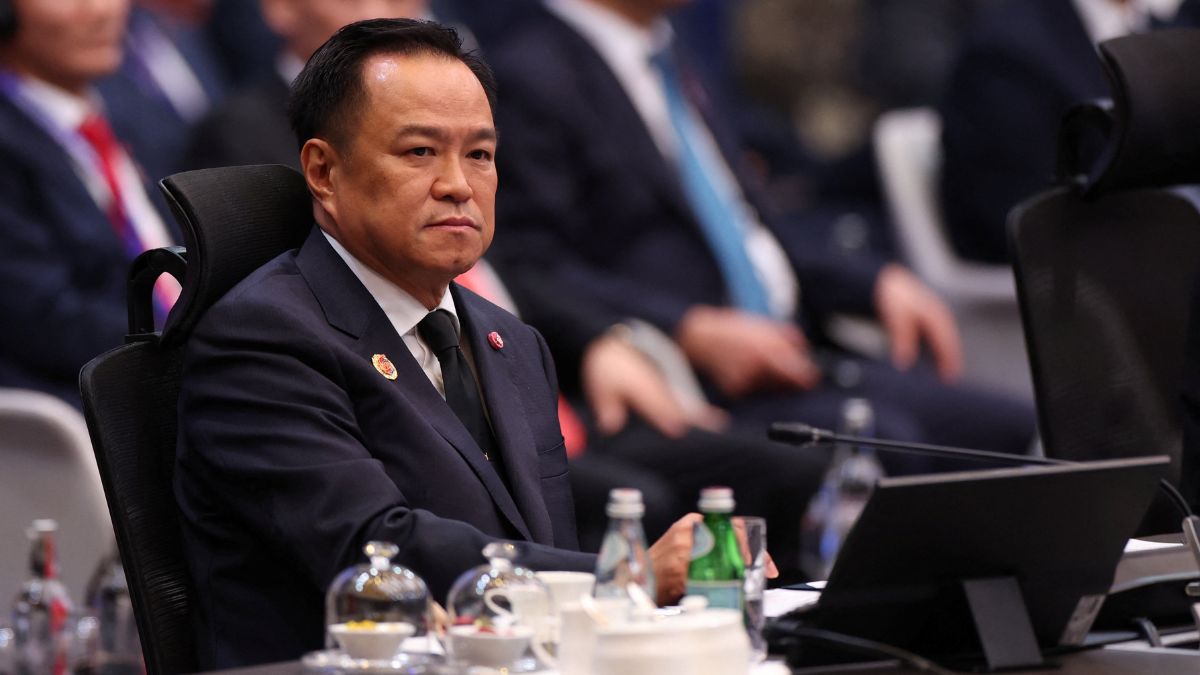
 "Did Thai PM Anutin push Thailand to war with Cambodia? – Firstpost")
As the Thailand-Cambodia conflict drags on, the spotlight has fallen on Thai Prime Minister Anutin Charnvirakul and his tough rhetoric. There are concerns that the conflict could spiral out of control as he might want to ride on the resultant nationalist wave to gain advantage in the next year’s election.
As the renewed Thailand-Cambodia conflict has dragged on, the spotlight has fallen on Thai Prime Minister Anutin Charnvirakul and his tough rhetoric.
While Anutin’s hawkish stance appears to have bolstered his image domestically, it has led to concerns it could fuel the fighting and have an adverse effect on peace efforts. After the
latest round of fighting broke out, he announced the war would only end on Thailand’s terms.
“From now on, there will be no negotiations of any kind. If the fighting is to stop, Cambodia must follow the course of action set by Thailand,” Anutin said on Monday — the same day he rebuffed mediation by Malaysian Prime Minister Anwar Ibrahim.
“Thailand’s direction remains status quo. No ceasefire,” Anutin said in a terse statement as he rejected a media report about Malaysia-mediated ceasefire.
The ongoing Thailand-Cambodia fighting is rooted in
a war that erupted in July, which in turn was the culmination of monthslong tensions began in May. And these tensions were the latest chapter in the decadeslong territorial dispute over the trijunction of Thailand, Cambodia, and Laos.
The disputed area, which is known as the ‘Emerald Triangle’, contains several cultural sites of high strategic and symbolic value to Thailand and Cambodia, such as the Prasat Ta Muen Thom temple, which are claimed by both the countries.
The Thailand-Cambodia conflict in July ended with
a peace deal brokered by US President Donald Trump, but the agreement now stands battered as multiple rounds of fighting have occurred despite its signing.
Is Thai PM fuelling conflict for political gain?
Anutin has learnt from his predecessor, Paetongtarn Shinawatra, who was ousted after a leaked phone call with the de facto Cambodian leader, Hun Sen, led to allegations of her being deferential to him and betraying her own country’s military.
The nationalistic outrage and subsequent sacking mean that Anutin cannot afford to be seen as weak regarding Cambodia. But his position has led to concerns that he could be going well beyond the firmness that the situation warrants to use the rhetoric and resultant nationalistic surge to personal advantage in the general election that is expected to be held next year.
“It’s very serious, I think he means what he says. His posture is no-nonsense (and) tough-talking, but he means it,” said Thitinan Pongsudhirak, a political science professor at Chulalongkorn University, told The Strait Times. “There’s an election coming up (in Thailand). There’s an incentive for him to benefit from nationalism at home.”
Moreover, there is a case for Anutin to be harsh on Cambodia as to not alienate the public — something that his predecessor was ousted for.
The view among the Thai public is that, despite its relative economic power and far stronger military, Thailand has not been able to effectively deter Cambodia from border incursions and perceived interference in Thai politics, according to Tita Sanglee, an associate fellow at Singapore’s ISEAS-Yusof Ishak Institute.
“From the Thai perspective, if you don’t deal with Cambodia now, then the issue will flare up anyway. So there’s this perception that you have to deal with it once,” Sanglee told The Strait Times.
But Sanglee said much of the tough talk is probably bluster and Anutin is likely banking on international pressure and diplomatic intervention providing a chance to de-escalate before things get too out of hand.
Trump has said that he will hold calls with Thai and Cambodian leaders on Thursday regarding the fighting.
Sanglee said, “Certainly, he wants to be, in practical terms, more tough than the previous government, because he has always been aligned with the military. We should probably expect to see Thailand try to make as much strategic gain as possible on the ground before another ceasefire.”
End of Article