

Initial plans for the Thai border town to thrive as an industrial hub faltered; now, sparks of development flicker in consumer demand and cross-border trade
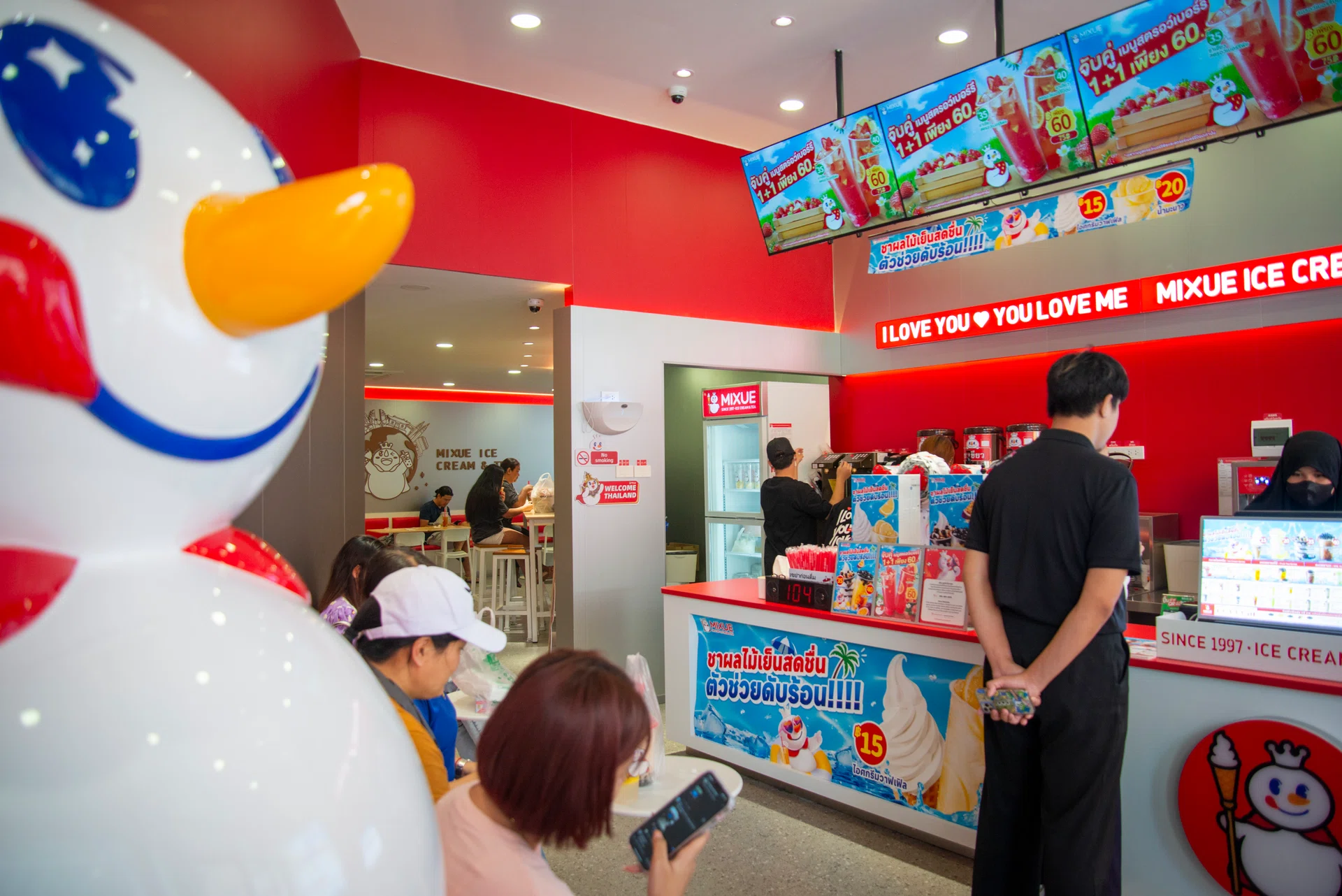
[MAE SOT, THAILAND] Rounding the corner of Prasatwithi Road, one of Mae Sot’s busiest streets, a crimson sign bursts into view cutting through the modest storefronts. The Mixue logo panel, emblazoned with its cheery snowman mascot, sits atop glass doors that open into a bright LED-lit interior.
The lunch crowd is slowly trickling in – families with bubbly children and vendors from the nearby market ducking in from the scorching sun – all looking for a sweet swirl of indulgence in a 40 baht (S$1.62) vanilla ice cream cone.
Mixue – the Chinese company that is now the top-selling bubble tea and ice cream brand in Thailand – has already staked its claim in this quiet border town. But this globally recognised franchise is not the only international flavour to sweeten Mae Sot’s mix of businesses.
With the influx of international franchises and shifting preferences for their products, Mae Sot is no longer just a border town and is gradually becoming a regional economic centre, said Dr Rattaphong Sonsuphap, an associate professor at Rangsit University’s Faculty of Economics.
The transformation is most evident at the Robinson’s outlet mall across town. Inside, recognised brands like Dairy Queen and Swensen’s are nestled alongside restaurants dishing out traditional Thai and Myanmar cuisines.
Behind most of these familiar names is Xu Yu Ying, a Thai-Chinese entrepreneur who set up all 10 franchise outlets of these international brands in Mae Sot throughout the past year.
Mixue is the latest in the 38-year-old entrepreneur’s growing portfolio. Her fifth franchise – a yakiniku (Japanese barbecue) restaurant – opened its doors in September this year.
Behind the flurry of international food chains in Mae Sot is the rising demand among locals.
“Local consumers are increasingly adopting consumption behaviors associated with urban lifestyles,” noted Dr Sonsuphap.
SEE ALSO

The shift is not only visible in food, but also on the streets.
Along the dusty roads of Mae Sot, in place of the rumbling engines of petrol cars, are silently gliding electric vehicles.
“Many locals in Mae Sot drive BYD cars, especially the Dolphin model. It probably started around 2022 when the service centre became available,” said Kai, a 43-year-old Grab driver.
A vision derailed
When the Thai government designated Mae Sot as a Special Economic Zone (SEZ) back in 2015, the blueprint was far more ambitious – to transform the border town into a manufacturing and logistics hub connecting Thailand to Myanmar, anchored by major industrial players.
An SEZ is a selected area where governments offer special incentives like tax breaks and relaxed labour laws to attract foreign investment and boost economic development.
But before these new businesses could flourish, the triple blow of Covid-19 restrictions, Myanmar’s 2021 military coup, and the emergence of criminal scam centres in Myawaddy (a town in southeastern Myanmar) brought these plans to a standstill, as travel across the border began to tighten.
Nisit Sungsuwan, a local research specialising in the Mae Sot SEZ, said that several hundred thousand Myanmar migrant workers returned home in 2020 and most of them were unable to return due to the border closures.
Major investors like Thailand’s petrochemical company PTT Global Chemical and consumer products conglomerate Saha Group, who had signed memoranda of understanding and begun construction of projects, withdrew their commitments.
“There was a lack of confidence in long-term investment prospects, largely due to inconsistent policies, administrative inefficiencies, and inadequate infrastructure,” explained Dr Sonsuphap.
A silver lining in the shadows
For a moment, Mae Sot’s development was stuck in time. What has kept Mae Sot afloat, however, is an economy that operates largely in the shadows, said Dr Sonsuphap.
In 2023, trade at the Mae Sot-Myawaddy border accounted for 130 billion baht, representing 11.6 per cent of Thailand’s total border commerce.
But this figure only captured the formal economy.
According to Dr Sonsuphap, the informal sector – encompassing everything from undocumented garment production to cross-border smuggling – can generate an additional 40 billion baht to 130 billion baht in economic activity.
“Even though such factories are registered legally, the workers are not legal labourers,” said Sai Aung Tun from MAP (Migrants Assistance Programme) Foundation, a local non-governmental organisation supporting migrant labourers’ human rights since 1996.
With employers routinely withholding overtime pay, confiscating worker documents, and violating minimum wage laws, some paying less than 352 baht per day, workers have nowhere to turn to.
“Most migrant workers don’t know the Thai language or laws,” added Tun. “They just need employment fast.”
Dr Sonsuphap said: “Foreign investors and large-scale enterprises tend to avoid regions associated with illicit activities, thereby undermining Mae Sot’s strategic potential to serve as an international trade gateway.”
However, improvements to worker protections have made the town more attractive to international businesses concerned about labour laws.
One of the ways MAP Foundation extends a hand to these migrant workers is through collective bargaining efforts. Under the Thai Labour Relations Act, workers can form negotiating committees if at least 15 per cent of employees sign a petition demanding changes to working conditions.
“We train them and advise them,” noted Tun. “They have to choose representatives – usually seven people – for the negotiation team with the employer, plus one adviser and an interpreter.”
This has improved conditions at several factories, securing proper documentation and basic workplace rights for thousands of workers.
Thailand’s Emergency Decree on Foreign Worker Administration – a reform aimed at protecting foreign employees – now mandates that employers provide health insurance coverage as a condition for work permit renewal.
Despite a decade of setbacks that derailed grand plans for the SEZ, Mae Sot is experiencing an unexpected revival.
“The entry of international franchises and the local purchasing capacity for electric vehicles serve as indicators of Mae Sot’s economic potential,” Dr Sonsuphap pointed out.
Whether this shadow economy-driven growth can transition into sustainable development depends largely on Myanmar’s stability and Thailand’s willingness to integrate these under-the-table activities into the formal economy, he felt.
For now, Mae Sot quietly edges forward, driven not by the logistics hubs once envisioned by policymakers, but by a surge in cross-border activities of Chinese investors.
The writers are final-year communications students at the Nanyang Technological University’s Wee Kim Wee School of Communication and Information. This report is the first in a two-part series from their trip to Thailand, produced as part of the school’s Go-Far overseas reporting programme.
Decoding Asia newsletter: your guide to navigating Asia in a new global order. Sign up here to get Decoding Asia newsletter. Delivered to your inbox. Free.